WHO by Wil Aime, Caribbean representation challenges
Will Wil Aime be the Christian Lara of his generation?
When a poster for “WHO” first popped in my Instagram feed, it immediately reminded me of the poster for Christian Lara’s final film: “The man with a stick —a Creole legend” released in 2023. Since every detail matters, I wondered if Wil Aime was paying homage to Guadeloupe’s most prolific director. From a Karukerament perspective, it would have been symbolically powerful for a filmmaker of Guadeloupean descent to use his first feature film to affirm a connection to the “father of West Indian cinema”… Especially since the majority of filmmakers in their thirties and forties from Guadeloupe and Martinique publicly refuse to use Guadeloupean and Martinican cinema as points of reference in developing their artistic vision—except to claim that they do better than their predecessors, while remaining incapable of offering any critical analysis of Caribbean films made before them.
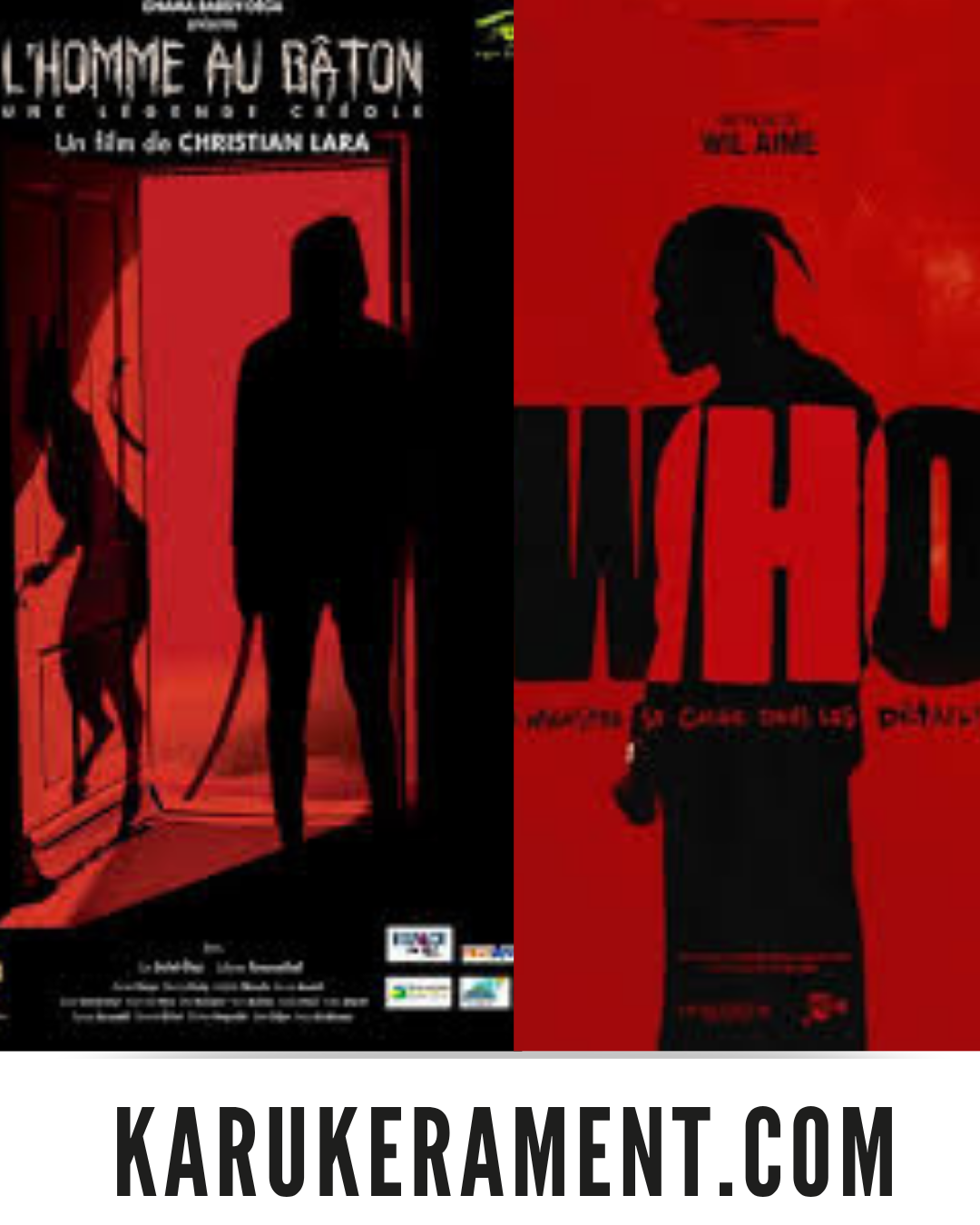
When I watched “WHO”, I found some positive aspects (the spiral-like storytelling, the exploration of religion) and negative ones (the spiral-like storytelling, the female characters serving as foils, the ineffective dialogue) that I had also found in Christian Lara’s latest film. From “Harry Potter” to French actor Louis de Funès, including “The Matrix” and anime series like “Attack on Titan” or “Death Note”, Caribbean influences are absent from his sources of inspiration, so I wondered if these similarities with Christian Lara were coincidental or if I was projecting my own Karukerament perspective. Indeed, beyond the fact that Wil Aime is figuring out a viable independent production business model in the 21st century—just as Christian Lara did to produce more than 25 feature films over some forty years— “WHO” crystallizes the challenges of representing the Caribbean:
identifying a territory
identifying a culture
identifying a community
Why? Without going into detail, it is culture that allows a community to find its own value. People from Guadeloupe and Martinique identify with an “Antillean” culture, but most artists view themselves solely through a colonial lens, which creates a disconnect with the “Antillean” audience. Without the right frame of reference, everything can look like a caricature, but Christian Lara’s dramatization works because he grounds his narrative in Guadeloupean culture, whereas Wil Aime relies on a false “Antillean” neutrality that reduces the Caribbean identity to a nearly anecdotal role.
identifying a territory
By constantly hiding behind the catch-all term “the Antilles” and validating the visual conventions of the colonial filter, we still haven’t created a visual identity unique to Guadeloupe. And it’s not for lack of iconic landmarks such as Place de la Victoire, the Moule, Sainte-Anne, and Basse-Terre boulevards, La Soufrière, the Alliance Bridge, and Pointe des Châteaux—not to mention the unique character of Les Saintes island, Marie-Galante island, and La Désirade island. Sugarcane fields and rows of dilapidated public housing shouldn’t be the only reference in the audience’s imagination. The generation of filmmakers whose points of reference are “City of God” and French suburban films of the 1990s continues to explore an aesthetic of the urban landscape at the expense of showcasing the diversity of the Caribbean’s natural settings. The universality of human beings means that a story set in Martinique could just as easily take place in Guadeloupe—and vice versa—but it is up to cinema to adapt its portrayal so that the audience understands these are not interchangeable territories. This is a pitfall that the films analyzed in the Karukerament podcast overlook, but one that “WHO” fails to avoid. While using a Caribbean visual language, Wil Aime chooses to create ambiguity around the territory he is depicting.
Located in the New World, this region of the Old Continent follows its own rules.
This is the first piece of information provided in the series of title cards that punctuate the film. Apparently, these are Wilson’s notes. Wilson is the intern who unwittingly finds himself a witness to the drama… One could see this as the storytelling technique used in manga and anime—creating a neutral universe that nonetheless resembles our reality. Except that expressions such as “New World” and “Old World” are anything but neutral when paired with the Caribbean visual imagery… Beyond the fact that the phrase reflects a colonial lens (if you don’t specifically say the land belonged to no one, “New World” is new only from the colonizers’ perspective), this territory is characterized by the fact that it follows its own rules… This implies that this region exists outside a certain framework, but which framework are we talking about? It is therefore not the neutral world of a fairy tale that the introductory animation sequence invites us into. This title card signals that overarching power dynamics are at play, but—unlike in anime where such dynamics would at least be in the background of the plot—this overarching framework remains invisible. So what’s the point of inventing an entire universe based on a colony-metropolis relationship without spelling out the terms, without showing the impact of that relationship on the characters’ daily lives—other than the fear of going to prison?
After the title card, the opening montage sequence underscores this lack of geographical context. According to interviews with Wil Aime, it’s supposed to be a nod to Guadeloupe… Except that this staging actually makes it just a mundane backdrop rather than a living, breathing place. Budget constraints do not justify this lack of specificity regarding the location. In fact, the opening sequences of classics such as “The Harder They Come” (1972; Jamaica), “Bim” (1978; Trinidad and Tobago), “Coco La Fleur candidat” (1979; Guadeloupe), “Rue Cases-Nègres” (1982; Martinique), “Ava & Gabriel, a love story” (1990; Curaçao), and “Barikad” (2001; Haiti) have established a tradition of subverting or subduing the postcard-style representation to dive directly into the distinctiveness of the Caribbean by showcasing the community first.
Similarly, the scenes in the space base offices (a nod to French Guiana, where he researched the criminal underworld for his film), the interior scenes in minimalist settings, and the sequence at the highway rest area showcase a variety of settings that make sense from a storytelling perspective but do not give the impression of being real-life spaces. The fleeting images of the Morne-à-L’eau cemetery serve as a reminder that depicting a specific region doesn’t require elaborate staging when the focus is on highlighting a particular cultural element.
identifying a culture
For about two years now, “back home in the Caribbean” has become the catchphrase content creators use before making a trite statement about Creole, music, Carnival, or cuisine. The challenge of portraying ordinary daily life in Guadeloupe without focusing on violence is very real. A community of people unable to define their own joy is willing to do anything for an illusion of joy—even if it lasts only a few seconds.
Even though “WHO” takes place over a short period of time, we don’t get to see the characters go about their lives. We don’t know what they eat, what they do in their free time, what kind of music they listen to, where they hang out, or who’s in their inner circle… Since the story isn’t set entirely behind closed doors and some characters have their own standalone scenes, the audience is entitled to wonder about this “region of the Old Continent transplanted into a New World.” We know it’s a hub for drug trafficking, but what else? How do people live there?
This isn’t just a matter of budget but of representational choices. The choice to depict Jahnaël eating French Fries at a highway rest stop rather than next to a food truck. The choice to portray Black men with well-groomed, neatly trimmed beards, even though their grooming routines aren’t depicted. I won’t comment on clothing as a means of asserting cultural markers, especially given the ongoing allegations. People listen to the radio for Wilson’s message and nothing else—not even obituaries…
This cultural contextualization could have been achieved through the dialogue and the chosen references. I’m not a fanatic about using Creole as a guarantee of authenticity, but it remains the language of emotion. And in a tense two-hour film where the characters all speak French in the same way —except for the “négro,” [t/n: nigga?] which, as far as I recall, is used exclusively by Black characters—I found it odd given that the film’s world employs a Caribbean visual aesthetic. It may be a prejudice on my part, but the fact that religion is the only cultural marker bothered me. Especially since this cultural marker applies only to the Black characters…
identifying a community
Wil Aime says that his Guadeloupean roots have influenced the creation of his characters. There are (too?) many characters, but do they truly reflect the natural diversity within a community of people? It would be interesting to learn more about his writing process because this group of characters doesn’t seem to have any connection to this region other than to exploit it. Indeed, the screenplay makes a point of showing that Wilson does not live in this “region of the Old Continent” without explaining why this distancing was necessary. Apart from Jahnaël, whom we see as a child, Juliette dos Santos—the widow of the region’s most notorious criminal—is the only character who has an emotional connection to this territory, having spent at least 30 years there. Furthermore, the fact that the character shares the first name of Wil Aime’s grandmother, to whom he dedicated this film, gives even greater depth to this world.
But what about the other characters? Living up to their full criminal potential seems flimsy as a reason for existence in an environment where the other inhabitants are absent. This difficulty in portraying the Caribbean with its inhabitants is one of the contemporary challenges of our representation. I admit I don’t understand this fascination with criminals, which, in reality, are (still?) a minority. But at least we’re dealing with high-level criminals here, proving that it’s possible to show something other than the drug dealer standing at a street corner. On the other hand, the portrayal of an ordinary young man like Wilson—that is, characters who reflect the majority of these filmmakers—doesn’t seem to inspire them much to stop treating the Caribbean as a lawless zone and instead portray it as a place where a community builds its life against all odds.
That said, according to the typology established by Dr. Guillaume Robillard in “Un cinéma décolonial : les personnages du cinéma antillais” [A decolonial cinema: Caribbean cinema’s characters], Wil Aime has written his own variation on two archetypes of Guadeloupean cinema: the storyteller and the gadèdzafè-kenbwazè (the sorcerer-medium). Often criticized for being overly explanatory, the voice-over belongs to the storyteller. With the opening animated sequence, Wil Aime sets the stage for the oral tale. It is up to each viewer to allow themselves to be guided by the voice from beginning to end, just as when listening to a story. But giving this voice to Wilson—who is omnipresent but not omniscient like a true voice-over—robs the audience of its freedom of interpretation.
Often criticized for its special effects, the character of Moses is the gadèdzafè-kenbwazè who steps into the spotlight instead of remaining in the shadows. Even if Moses isn’t who we think he is, my argument concerns only the choice to portray the archetype. Despite the exaggerated staging, his “powers” are questioned without ever being ridiculed. He does not appear as a secondary character serving others but is at the center of the plot. That said, do these archetypes make sense without the cultural context to which they are tied? Does the magical-religious element characteristic of the Caribbean have the same impact when the staging reveals the flip side of mysticism?
Beyond that, “WHO” is a film for men. Our society has a collective narrative about the “fanm potomitan”—about how the private sphere is organized around a matrifocal structure—but there are very few films made by men from Guadeloupe and Martinique that portray these non-White Caribbean women outside their roles as mothers, daughters, sisters, or (sexual) partners. Non-white female characters who make no decisions, who are there only to commit or suffer violence or to support a male character—this is one of Wil Aime’s storytelling signatures. As I mentioned in my episode on Guadeloupean film “Trafik d’Info”, I find it troubling that the majority of filmmakers who identify as “Caribbean” do not give non-white actresses more complex female roles. And I’m not talking about colorism, which is often justified by “she was the best candidate”—though that’s a topic for another day—I’m really talking about the depth of their female roles in general, regardless of the actress’s skin tone.
As a woman from Guadeloupe, as an Afro-Caribbean, Black, and French woman—my question is always: why are people so comfortable showing the (abused) bodies of Black women? This is all the more glaring when there’s a white female character that allows for a direct comparison of the difference in how they’re portrayed. With that in mind, I propose the Karukerament test to evaluate the representation of Caribbean women in our fictional works. It’s a variation on the Bechdel test.
Karukerament Test
Question 1: Are there more than one female character clearly identified by a name and at least one specific Caribbean origin? Simply saying that a character is from the Caribbean is too vague. Our cultures are not interchangeable. A specific Caribbean origin means naming the country, even if it’s an imaginary one. Furthermore, when I say “Caribbean woman,” I definitely include Black, Asian, and White women.
Answer for “WHO”: No. There are Juliette, Suzanne, and Arianne, so it would have been possible if this “region of the Old Continent” had a name—even an imaginary one. If Mose’s indoctrinated followers had had first names, it might have worked.
Question 2: Do these female characters exist outside their roles as mothers, daughters, sisters, or (sexual) partners? In other words, are the female characters autonomous within the plot?
Answer for “WHO”: No. They could have been if it had been confirmed that Ariane or Juliette was born in that region.
Question 3: Do these female characters remain clothed from beginning to end?
Answer for WHO: No. It could have been the case if Moses had been portrayed differently or if the white female characters had been defined as Caribbean.
How can we talk about originality if our filmmakers’ system of representation reproduces the power dynamics viewed through a colonial lens? From a Karukerament perspective, it’s impossible. This question becomes all the more pressing when artists remind us that they create with complete independence… So, if you have control over your creative work and yet end up with a representation that doesn’t deviate from the colonial lens, what’s the point?
Being the first to do something and the complexity of a plot do not hide the one-dimensionality of a universe that is entirely of one’s own creation. Is that a problem? No. Does a limited budget prevent one from addressing these issues of representation? No, not at all. Caribbean filmmakers of previous generations worked with limited budgets and managed to create universal stories, some of which have left their mark on the history of world cinema.
It remains to be seen whether filmmakers of my generation will do the same. In any case, Wil Aime has already accomplished the most difficult part of an artistic career: forging a connection with an audience that wants to see him succeed. That’s the missing link for our filmmakers. While the Black community—particularly “the Caribbean audience”—is vilified for its lack of support, how does “WHO” prove the existence of a supportive Black community? For the Karukerament answer, click here.