Netflix "Bandi", an intentional ambiguous marketing strategy?
Why not a Netflix "Caribbean Fantasy" or "Caribbean Thriller" section in the 21st century? Alain Bidard asked in our Karukerament interview in February 2020.
Since Karukerament launched in 2019, I’ve seen how audiovisual content from Guadeloupe and Martinique has gained visibility. Through conversations with Caribbean American filmmakers like Stefon Bristol, I realized that Caribbean storytelling could now break out of the festival circuit and reach a wider audience. Production and distribution experts at the virtual roundtables of film festivals in 2020 and 2021 were unanimous in their view that Caribbean filmmakers had an opportunity to showcase their work on the international stage. That’s why I wasn’t surprised by the success of Nelson Foix’s “Zion” and Jean-Claude Barny’s “Fanon” in 2025. Without the “outrage” marketing strategy, I even think they would have reached an even wider audience, but that’s just my opinion. I’m not saying this to downplay their achievements. The success of these two films seems phenomenal from a French perspective. From a Caribbean perspective, it’s the continuation of the marathon that began in the 1960s. These successes confirm what non-French industries have been saying for over a decade. So, rather than getting stuck on artistic quality or the budget invested as the sole reasons for success, today I’d like to offer some food for thought on the marketing of Caribbean fiction, using the example of “Bandi” just a couple of weeks before its release.
A Favorable Netflix Landscape
From 2015 to 2025, Netflix released teen-led dramas across a variety of genres, including fantasy, thriller, comedy, and romance. Pre-2020 pop culture blogs were abuzz with analyses of “Stranger Things” (2016–2025), “13 Reasons Why” or “Greenhouse Academy” (2017–2020), “Atypical” (2017–2021), “Anne with an E” (2017–2019), “Grand Army” (2020), “Sex Education” (2019–2023), “The Umbrella Academy” (2019–2024), “Heartstopper” (2022–2024), and the “The Kissing Booth” film trilogy (2018, 2020, 2021). The most recent example of these teen-focused productions sparking discussion is undoubtedly “Adolescence,” available since 2025. The lifestyle in the United States and England was an integral part of this universal portrayal of youth.
At the same time, Netflix has openly diversified its editorial lineup with youth-oriented fiction driven by specific cultural identities. This was the marketing pitch for hit series such as “The Get Down” (2016–2017), “On My Block” (2018–2021), “Never Have I Ever” (2020–2023), “To All the Boys I’ve Loved Before” (2018, 2020, 2021), “XO Kitty” (2023), and “Forever” (2025–). The teenage experience in other countries has also been portrayed, as in “Elite” (2018–2024) in Spain, “Blood and Water” (2020–2024) in South Africa, and “AlRawabi School for Girls” (2021–2024) in Jordan. Not to mention the influx of teen K-dramas starting in 2020. Thus, these series draw on stereotypes of youth, such as learning about love and sexuality, parental pressure, and bullying, while offering a universal plot tied to a specific cultural or even identity-based context.
For Netflix France to embark on a project like “Bandi” in this context isn’t exactly a huge risk… Indeed, from “Le Temps des copains” to “La Vie devant nous”, via “Pause-Café” and the AB sitcoms (“Premiers Baisers”, “Hélène et les garçons”, etc.), France has always been both a producer and consumer of fiction centered on teenagers and young adults throughout the second half of the 20th century. In the 1990s and up through the early 2010s, France Télévisions also had its share of cult youth series such as “Foudre” and “Coeur Océan”, highlights of its KD2A lineup. Starting in the 2010s, the group shifted its editorial direction with youth programming increasingly targeted at children under 10. Teen dramas such as “SKAM France” (2018–2023) and “CUT!” (2013–2019)** were designed for streaming and served as experiments in transmedia storytelling on secondary channels like Slash and the now-defunct France Ô. Thus, Netflix’s “Mortel” (2019–2021) launched amid favorable momentum without capitalizing on the French tradition of youth fiction. Despite its clumsy portrayal of Guadeloupean culture, “Mortel” had a solid first season that raised expectations for the next original youth project capable of rivaling productions from other countries. Will the series “Bandi” be a winning bet for the streaming platform? Only time will tell, but what marketing strategies have been put in place to ensure its success?
The Ambiguity of the series genre
The Netflix history I’ve just outlined focuses on youth fiction, which is the default genre I’m currently assigning to “Bandi” based on the poster and the trailer… Previously, the series was marketed as a gangster series, so I thought it would be the story of a group of adult siblings in the vein of “The Sopranos”. Especially after reading the AFP press release published in April 2025…
Filmed almost entirely in Martinique, Bandi follows a family “that is suddenly thrust into the criminal underworld” after the mother’s death, explains Pauline Dauvin, Netflix’s Vice President of Content for France. [...] “We wanted to make a series that stands out from the settings we often see” in “gangster stories,” summarizes Eric Rochant, on the sidelines of filming in Saint-Joseph in mid-April [2025].”
The phrases “almost entirely filmed” and “the criminal underworld” already gave me the impression that there would be an outsider character dropped into Martinique. In my view, the decision to tell a gangster story—rather than a family story—placed this fiction firmly within the adult thriller genre. I knew I wouldn’t be the target audience, but the line that convinced me was:
In the director’s eyes, Martinique’s natural setting offers “an image that is not the same” as in mainland France. The environment “is extremely colorful” and “brings to mind Brazil, Cuba,” he summarizes.
You can check out Karukerament - Episode 5 on “Guava Island,” where I describe the exploitation of Caribbean cultural identity by decontextualizing our existence. As I’ve already said, the current use of the term “Antilles” or “Antillean” reflects the idea that Guadeloupe and Martinique are interchangeable… Which is not the case. And audiovisual fiction should help differentiate us in the mainstream imagination. That was the intention of Bertrand Cohen and Stéphane Meunier, who highlighted the uniqueness of New Caledonia in “Foudre” and of Réunion island in “CUT!”. Thus, Eric Rochant’s phrasing gave me the impression that Martinique had not been chosen for its distinctiveness but for its resemblance to established cinematic references in the portrayal of the Black gangster milieu… The series is described as “the Netflix series from the creator of “The Bureau of Legends”… So, I understand the appeal of riding on the success of “The Bureau of Legends”, but that doesn’t change the fact that the series needs to be categorized so it can be linked to similar recommendations. In the articles posted on March 12, there’s talk of an “intense family drama” and a “Caribbean western”… My marketing question is: how will the algorithms promote this series if even the promotional content doesn’t classify it into any specific category?
Furthermore, I was puzzled to see that the word “Martinique” wasn’t consistently used in the synopses, particularly in the one for the Youtube trailer. This omission is all the more glaring given that the word “Martinique” appears in the Netflix summaries for other countries (2).
After losing their mother, they must unite, or destroy each other.
BANDI, the first Netflix series in Martinique, from the creator of The Bureau, premieres April 9.
So, while the written content surrounding the series gives the impression of promoting it, does it actually help establish its place alongside other Netflix series in the digital landscape? In any case, this pre-promotion focuses entirely on the Black characters while keeping them anonymous…
The main character’s ambiguity
Whose story will we follow? Who will the audience root for or root against? Who, aside from the mother, will die and break the audience’s heart? The written material only mentions a family or a group of siblings without specifying the central plot thread… The poster and trailer focus on the expected gangster element but not on the family element, which is what truly makes this story original. Upon reading, we encounter the usual stereotypes: a deceased mother, a father rendered invisible since they are orphans, delinquent teenagers… Certainly.
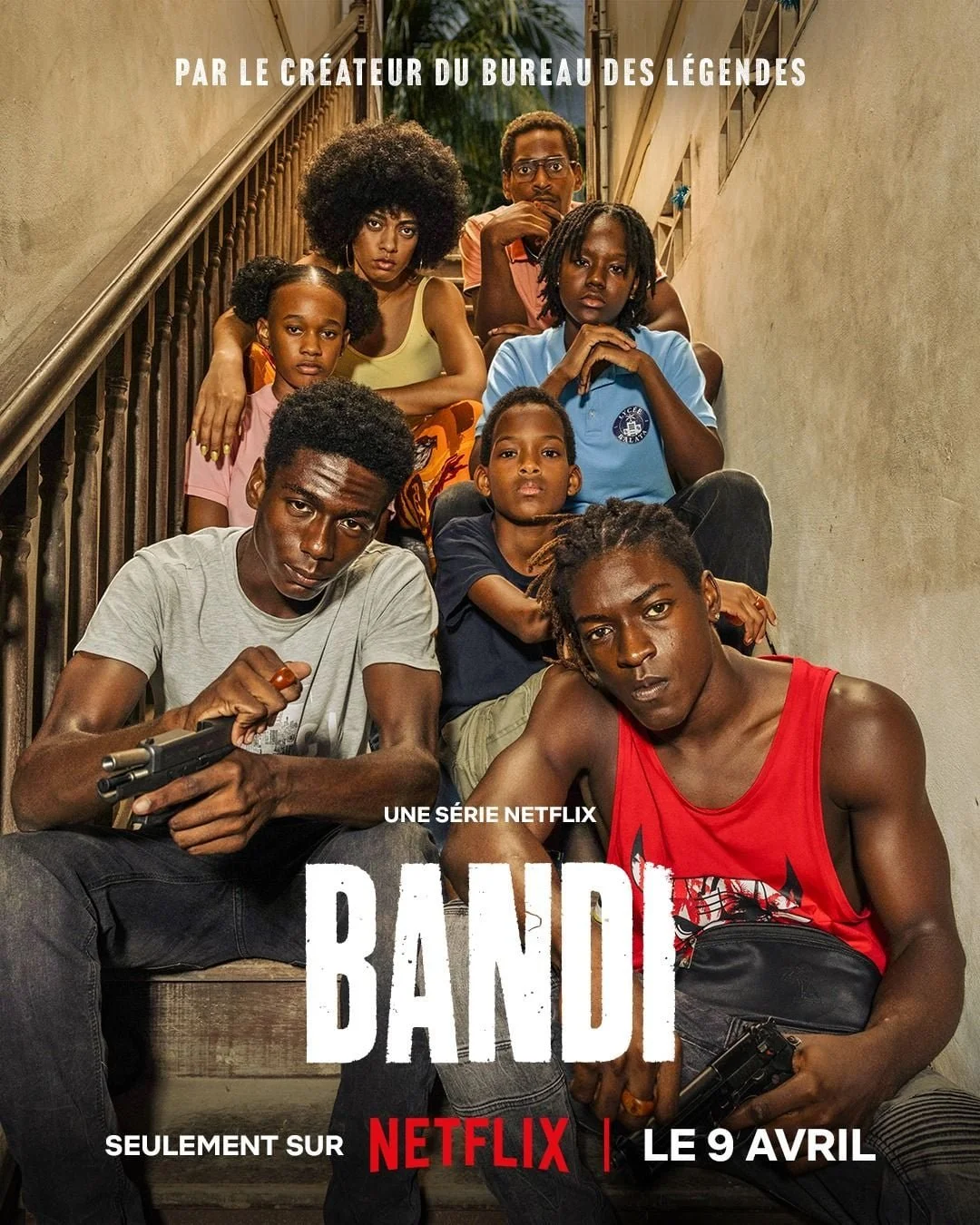
In the trailer, we see a bunch of kids, teens, and young adults with no first names, no last names, and no ages—except for the 16-year-old whose high school uniform we see… Sure. On the poster, I assume we see the seven main siblings since the family apparently has 11 children, as seen in a still published on ecranlarge.com (I really hope there aren’t any parents among the siblings). The characters seem trapped between two open-air walls, or at least a large window showing the outside with a palm tree in the background… This is the symbolism of what I will henceforth call the “banlieue film made in the Caribbean.” As I said in my French episode “Mortenol, Ti Moun Aw, Mauvais Choix,” the concept of the suburbs doesn’t apply in the same way here because we don’t have the same landscapes or the same urban planning as in France. The palm tree in the background, centered at the top of the image, may evoke the paradise that “the Caribbean” represents, while our characters are sitting on a staircase. Perhaps they are arranged in order of who is closest to death—with weapons in hand, that is, in a protective stance for their family but close to hell—while those furthest from it are positioned toward the top of the stairs? Apart from the teenager in her high school uniform, they wear no distinguishing marks that would give us any idea who they are beyond their criminal nature. This “mystery” marketing strategy featuring unknown actors might work for a series in France starring White actors, but it’s counterproductive in our case. To visually define the characters solely by the violence of their environment is to follow the classic pattern of portraying Black French characters whom the mainstream audience doesn’t care about in general. Where is the surprise or curiosity in terms of the characters? And even in terms of the actors and actresses…
If released between 2016 and 2021, “Bandi” ’s main marketing pitch would have been: “Come watch the first French series centered on a group of Black teenagers and young adults to be broadcast internationally.” I emphasize the word “series” because Netflix has produced films like “Banlieusards” where the cast is predominantly Black. However, in the French tradition of serialized TV, non-White teenage leads are generally female characters (“Foudre”, “Coeur Océan Season 5”, “SKAM France Season 6”) or biracial (Jules in “CUT!”, most of the characters in “La Baie des Flamboyants”)... Between 2016 and 2021, even without being classified as youth programming, having so many young Black lead characters would have been celebrated. Netflix would have capitalized on the Black Square Instagram trend, where certain platforms promised to take action against structural racism. In 2025/2026, the fact that this objective element (and not a subjective assessment) isn’t mentioned—to my knowledge, at least—raises questions about who will truly be at the center of the story and about the creator’s awareness of representation issues. Who plays these characters? Who will push their names into the algorithms? The pre-promotion doesn’t talk about them. That said, AI or not, I really don’t like the texture of the Black skin on the poster… It was the same with “Zion”’s poster, and I noticed that the poster for “Banlieusards 3” has the same vibe… In any case, the cinematography in the trailer is reassuring. Jimmy Laporal-Trésor [check out my episode on Les Rascals and Black Soldier] and Khris Burton, who are both excellent directors with projects that break away from conventional representation, directed some of the episodes, so I already know the visuals will be great. But what matters most of all is the plot. What’s the marketing angle for the story?
The ambiguity of the Plot’s Driving Force
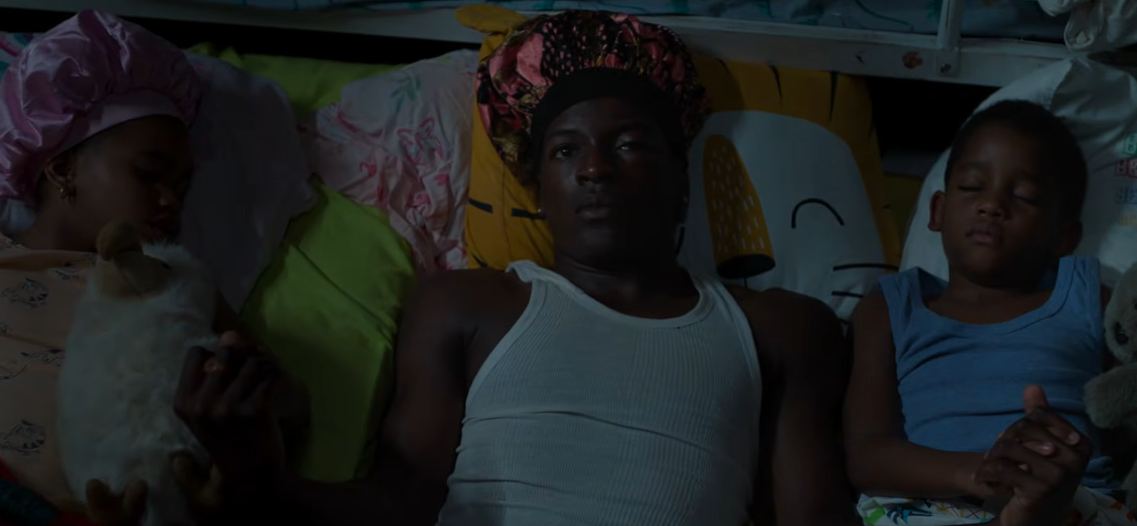
Violence or family? When I saw the poster and the trailer, my first question was, “Who’s going to die?” My second question was, “Will the series be pure entertainment, or will it be an original portrayal?” When I say “original,” I don’t mean free of stereotypes, but original in its reinterpretation of those stereotypes. Just as Ryan Coogler did in “Sinners” [read my comparative review with Rue Case-Nègres of Euzhan Palcy’s film], but in such a direct way—particularly in the portrayal of love between Black characters—that most analyses missed the originality of his approach. It’s this ability to consciously reinterpret stereotypes that I find in Caribbean cinema, but which clashes with the French perspective. That said, without being subversive, a story full of stereotypes can still be entertaining. My third question was: “Where is the sibling love?” It’s not enough to tell us that the siblings will do anything to survive. We need to be shown what makes them siblings. The family as a space of love and security is rarely at the heart of our stories. While our relationship to fatherhood can serve as a subject in cinema—as in “Elza” (2011), “Torments of Love” (2017), “The Bond That Unites Us” (2020), “Zépon” (2022), or “Zion” (2025), motherhood doesn’t particularly inspire filmmakers. Probably out of awkwardness or fear of examining dysfunctional behaviors, as in “Fichues Racines” (2011). In any case, exploring the theme of family from the perspective of a Black sibling group that loves one another… This is original from a French perspective because “Antillean people” are perceived as uprooted and adrift, incapable of forming families due to slavery, etc. This may be why the representation of family is the foundation of Caribbean fiction. Whether through blood ties or friendships, Caribbean fiction** shows how we maintain our community against all odds. This spirit of solidarity born of adversity is absent from “Bandi” ’s promotional material. If there are 11 children instead of 7, are they siblings, or are some of them being raised in the family because they are cousins, half-siblings, etc.? In the early 2000s, while not the norm, this type of family structure was by no means uncommon. In 2026, when Guadeloupe and Martinique have been despairing for some fifteen years over the decline in birth rates and the aging of the population, how realistic is this setup? This is the kind of question the trailer should have raised so that the online “Antillean” community would enthusiastically carry the project forward through tweets and reposts. The trailer shows only one image of sibling love, and they aren’t even facing the camera…
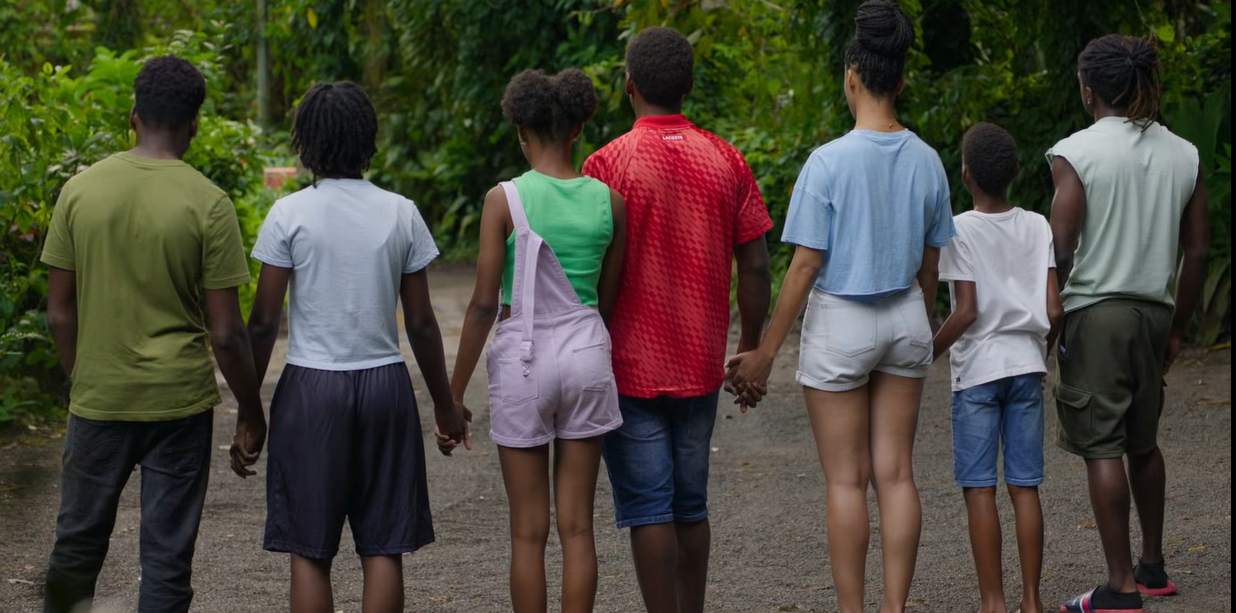
Whether positive or negative, the reactions sparked by the trailer keep circling back to the same false debates:
The absence of Creole in the dialogue… The title is in Creole. End of discussion. Since the title is in Creole, authenticity shouldn’t hinge on the language of the dialogue but on the content itself. The real originality would have been to create a trailer with no dialogue at all, precisely to spark the question, “Will they speak Creole or not?” From a Karukerament perspective, if Creole isn’t used to talk about love, we can do without it. #unpopularopinion
Yet another story about drug dealers… As I said, I have nothing against stereotypes because they determine the level of originality. From a Karurement perspective, the problem isn’t the theme itself but the fact that it’s always approached from the same angle. That’s what gets tiresome. Even though I only like romance, I’m always open to a story of redemption or an underdog triumphing. That’s what, in my opinion, makes “Bantù Mama” (2021) [read my review], which uses the same stereotypes from a different perspective: teens left to fend for themselves deal drugs to get by and take in a French woman wanted by the police for drug trafficking. The film does begin with the clichés before delving into each character through their dreams and hopes in the roughest neighborhood of the Dominican Republic. So yes, yet another story about drug dealers, but what matters is how it’s told. The trailer and poster just highlight Black French youth as seen through the colonial filter. Whether from a White perspective or from the perspective of those involved, it’s a clichéd portrayal… So, the marketing strategy focusing on the predominantly local technical crew becomes almost counterproductive in this context because we’re turned into a token element. If it succeeds, it will be thanks to the Bureau des Légendes stamp of approval. If it fails, the “Antillean” audience will be blamed for not supporting the first Netflix production filmed in Martinique enough, but what are the validation criteria, and which marketing strategy was applied to meet those criteria?

In an Instagram post on March 11, 2026, French media outlet Adelphite asked the question, “Are there any Black people on screen who aren’t drug dealers?” Citing bell hooks and Édouard Glissant, the outlet rightly points out that the narrative presented does not address structural issues… Except that, as I mentioned in the Karukerament French episodes for “Trafik d’Info” and “Coco La Fleur candidat,” our stories can be compelling without being a documentary. Our stories can have value without adopting a perspective of denunciation. Our very existence is already political. Our fiction can explain the why, but it should also allow us to escape, to develop our imaginations. Fiction should show us interacting as individuals with dreams, hopes, and ideals.
I’m willing to watch ten stories about a drug dealer, as long as they focus on the individuals themselves rather than their status as dealers. I’m thinking of the character Juan in “Moonlight” [read my review] or the teens T.I.N.A. and Shulo in “Bantù Mama.” They remain complex human beings seeking connection with others to remind themselves that they’re not just dealers. How and why they ended up in this situation isn’t the point, nor is their storyline. We see them (sur)viving in the present moment… So an “intense family drama” or a “Caribbean western,” fine, but it’s not enough to just tell us—you have to show us, too. And for now, the trailer and poster reveal nothing of this aspect.
Other elements gave me pause, but I’d rather wait before commenting, since they might only make sense after watching all the episodes—just like the trailer for “Sinners” only really makes sense after watching the movie. Plus, Netflix is known for not having consistent or effective promotional campaigns, so… In the end, beyond the confusing marketing surrounding Bandi, the Karukerament question is: are we on the verge of moving away from indie filmmaking and into a phase where our filmmakers receive direct funding instead of working on other people’s big projects? Will “Bandi” mark a decisive step toward establishing a genre of Caribbean-made content recognized by the mainstream audience - and not just at film festivals? That’s what some are enthusiastically claiming. We all want to believe it, but can this happen without implementing specific cultural marketing strategies? To be continued…
*I use the term “Caribbean” in the American sense, not as a synonym for “Antillean” as defined in the French sense—which refers exclusively to Guadeloupe and Martinique.
** Personally, CUT doesn’t fit my definition of a youth series, but the first three seasons were marketed to a young audience.
*** The entire selection of the Karukerament podcast, seasons 1 and 2, allows us to discuss our Caribbean concept of family. Recent films like “Freda,” “Kidnapping Inc,” “Bulado,” “Lorena,” and “Sugar Island” do the same. It’s the “Antillean” system of representation that glorifies the character of the Black man struggling alone against adversity to the point of relegating the family—especially the female characters—to the background…